July 24, 2026
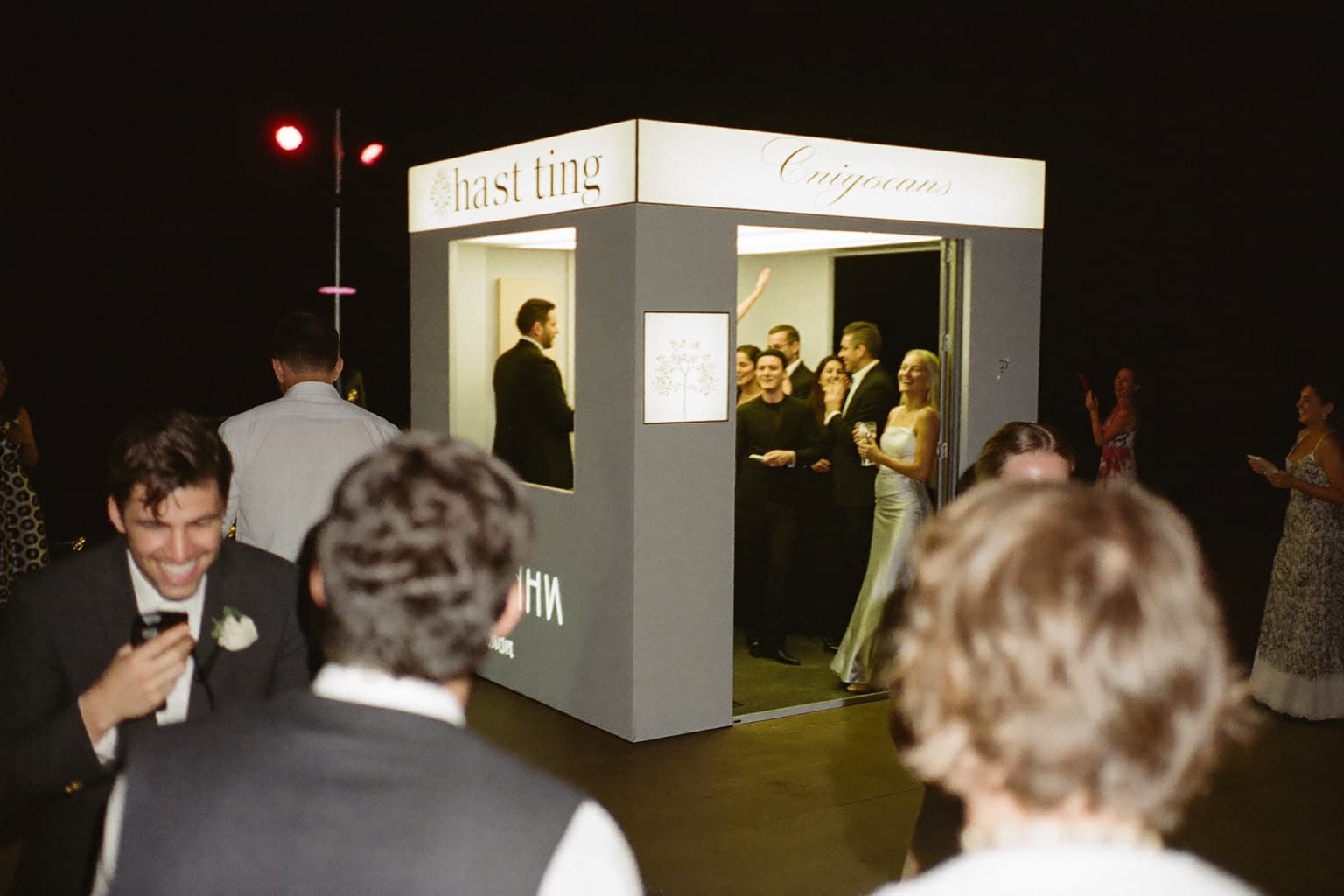
Match the booth hours to your timeline, not the clock
Most wedding photo booth rentals run three to four hours. The real question isn't how many hours — it's which hours. A booth that opens the moment guests arrive and closes before the dance floor fills up will photograph a half-empty room and miss the best part of the night.
Here's the short version: a wedding photo booth earns its keep after dinner, once the formalities wrap and guests loosen up. Everything below is about protecting that window.
One thing to know up front: every rental comes with an on-site attendant, so opening, pausing, and closing the booth around your schedule isn't something you have to manage on the day. Hand us the timeline and we work around it.
Cocktail hour: don't park a booth where nobody is
Cocktail hour looks like an obvious booth window — guests are fresh, hair and makeup are perfect, nobody's had four drinks yet. The problem is location. At most Connecticut venues, cocktail hour happens in a separate space from the reception room. If the booth is already set up by the dance floor, it sits unused for an hour you're paying for.
Two fixes:
• Bring the camera to the guests with a roaming booth — an attendant circulates through cocktail hour with a handheld rig, so nobody has to go find a booth.
• Skip cocktail hour entirely and stack those hours after dinner, where they're worth more.
If your cocktail hour and reception share one room, a stationary booth during cocktails can work fine. Otherwise, don't spend prime hours on an empty corner.
Dinner, toasts, and first dances: the booth goes dark
The photo booth should not run during toasts, parent dances, or your first dance. That's not an equipment rule — it's an attention rule. A photo booth is loud fun, and a laughing group under a ring light thirty feet from your best man mid-toast splits the room in half.
Practically, it doesn't cost you anything to close it: guests are seated for dinner, so booth traffic drops to nearly zero anyway. Our attendant can pause the booth through speeches — just put the toasts on the timeline you send us.
If you want a split schedule — a short early window, closed through dinner, then reopening for dancing — ask about it when you book. It's a common request, and it's much easier to plan in advance than to improvise with the DJ at 7pm.
The strongest window: open dance floor to last call
If you only book three hours, put all three here. From the end of the formal dances to the last half hour of the reception is when a photo booth does its best work:
• The dance floor feeds the booth a steady stream of groups all night.
• Your wedding party finally has free time instead of photo obligations.
• Older guests who leave early still catch the first hour of it.
Most receptions run about five hours, and the back three are booth hours. If yours runs longer, a four-hour block starting right as dancing opens covers nearly everyone.
One caveat: don't run the booth to the literal final minute. The last 15 to 30 minutes of a wedding are the send-off, goodbyes, and coat-grabbing — booth traffic falls off a cliff, so end the booth just before the reception ends, not with it.
The audio guestbook is the exception — let it run all night
Everything above is about concentrating booth hours where the crowd is. An audio guestbook works the opposite way: it's a phone on a stand that guests pick up to leave a voicemail-style message, and it shouldn't be limited to a window at all.
Set it near the entrance or the bar from the start of cocktail hour to the end of the night. Early messages tend to be sweet and composed; late ones get funnier. You want both on the recording.
Because it runs passively, it also covers the parts of the night the photo booth deliberately skips — dinner, toasts, quiet moments — without stealing attention from any of them.
A timeline you can copy
For a 5:00 cocktail hour and a 6:00–11:00 reception:
• 5:00–6:00 — roaming booth works cocktail hour (optional); audio guestbook opens
• 6:00–7:30 — dinner and toasts; photo booth closed
• 7:30–10:30 — photo booth open; this is the core three-hour block
• 10:30–11:00 — booth wraps; audio guestbook stays up to the end
Shift the clock to match your venue — the shape is what matters: booth hours stacked after dinner, quiet during the formalities, guestbook running wall to wall.
Hours are also the biggest lever on what you'll pay, so this plan doubles as a way to keep the budget sensible — our photo booth cost guide breaks down how hours and booth type move the number. It's the shape we recommend for receptions across Connecticut, from Danbury to the shoreline. If you have a date, check availability and we'll fit the booth hours to your timeline.